
The Evolution of the Standard Overhead Join at UK GA Airfields
The overhead join has long been a staple in the United Kingdom's general aviation (GA) community for entering the circuit at uncontrolled airfields. However, it's important to note that the so-called "standard" procedure is not a one-size-fits-all solution. In fact, at airfields where activities like skydiving or glider winching occur, overhead joins are often prohibited for safety reasons. This adds another layer of complexity to a procedure that, despite its deep historical roots, can be confusing, especially for pilots unfamiliar with a particular airfield.
It's beneficial to delve into the history of airfields to understand the current state of affairs. In the early 1900s, well before the advent of GPS and advanced avionics, pilots used basic navigation methods at an airfield. One such tool was the signal square—a ground-based layout near the control tower with various coloured patterns. These patterns provided crucial information such as wind direction, active runway, and other field-specific guidelines.

In the early days of aviation, aircraft often had open cockpits and lacked radios, forcing pilots to fly at low altitudes to identify signal squares visually. This resulted in circuit heights significantly lower than today's standard 1000 AGL. Heights typically ranged from 300 to 500 feet AGL, varying based on the airfield and aircraft in question. Naturally, the most straightforward way to read a signal square was to be directly over the airfield, peering down from an altitude higher than the circuiting aircraft—say, at 800 feet. Once the circuit direction was identified, pilots would roll out of their turn and descend on the "dead side" of the circuit to reach the appropriate circuit height before joining the established pattern.
Today, signal squares are a thing of the past, and circuit heights have generally risen to around 1000 feet AGL, necessitating even higher altitudes for overhead joins. Although being directly over an airfield no longer serves the purpose of reading a signal square, the terminology persists. Nowadays, an overhead approach should offer the pilot clear airfield visibility. If approaching from the right side of the airfield, pilots—typically seated on the left—will get an optimal view of both the runways and circulating traffic.
The most effective illustration of this concept can be found in a diagram provided by the UK's Civil Aviation Authority (CAA).
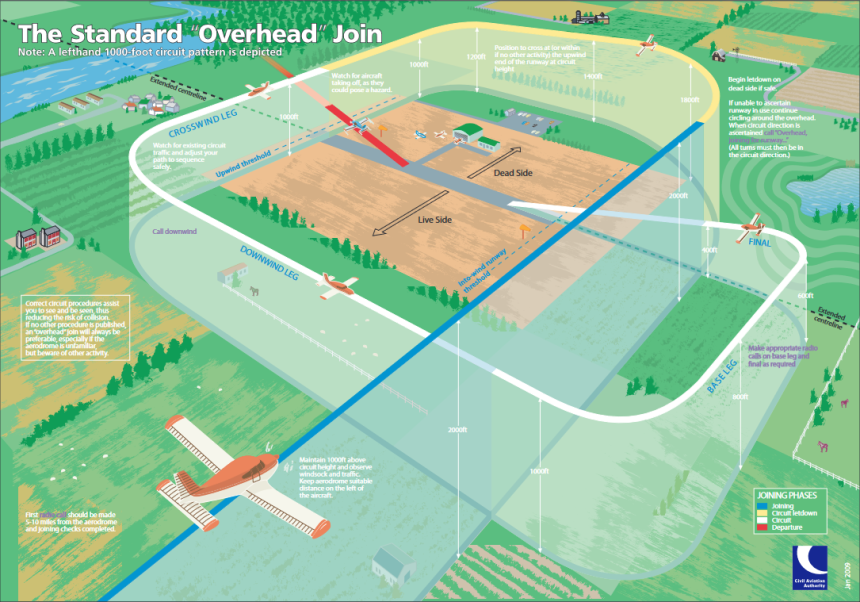
In the high-approach method (Overhead Join) the pilot keeps the airfield to their left while maintaining an altitude above the standard circuit pattern. This allows the pilot to get a good visual scan of the area while becoming acquainted with the airfield's layout. Once at circuit altitude, it's common to fly the crosswind leg directly above the number located at the end of the landing runway. However, aligning with other traffic in the circuit takes priority over following this specific path, making the numbers more of a guideline than a strict rule.
If you're coming in from the "dead side," aim to intersect the dead-side descent pattern as soon as feasible. Alternatively, you can circle around the airfield (Blue Joining Path) to join the pattern, as illustrated below. Apologies for the crude edit of the CAA graphics, but the concept should remain clear.

If you find yourself at a bustling airfield or are uncertain about the lay of the land, there's no need to rush your descent. You can perform an orbit at the "overhead" height—indicated by the blue line in the previous illustration—while listening to radio communications. This allows you to maintain a vigilant check on both your instruments and the airspace around you until you've acquired a clearer understanding of the situation. A simple radio call such as "G-ABCD orbiting at X feet due to traffic in the circuit" will suffice.
If you discover that the airfield operates a right-hand circuit, simply flip the visual guide in your mind. Remember that flying a right-hand circuit tends to afford less visibility for the pilot. As with the left-hand circuit, there's no need to descend until you're confident about your approach strategy.

In nations like the United States and Australia, the favoured approach is often to join the circuit pattern at a 45-degree angle to the downwind leg. This technique allows the pilot to evaluate wind conditions and the airfield's layout.
In the UK, certain airfields might host activities like skydiving or glider winching. Due to safety concerns—like winch cables ascending from the ground and skydivers descending—high approaches or overhead joins are typically not allowed at these airfields. Gliders usually take off into the wind, giving you a clue about the orientation of winch cables and where to watch out for gliders. Skydivers generally exit the aircraft on the upwind side of the airfield, so it's advisable to steer clear of that area, especially above 2,000 feet.
Now that we've demystified the somewhat confusingly named "Overhead Join" exploring the various circuit patterns you might encounter at airfields is helpful. Understanding these patterns will aid you in deciphering radio calls and aircraft movements. Standard circuit patterns are essentially rectangles superimposed over the runway, designed to be flown either left-hand or right-hand. The pattern may become more complex due to high traffic volumes, noise abatement zones, and other localised airspace restrictions. This makes it especially important to prevent the circuit from expanding outward excessively as pilots look to extend the various legs to create space between themselves and the aircraft in front. Maintaining a safe distance on busy days can be challenging when various aircraft are flying circuits at different speeds. Techniques like early turns and policies for moving to the side during a go-around have been implemented to alleviate this issue while ensuring good visibility of the runway and aircraft engaged in touch-and-go operations.

Much like other local customs, the circuit pattern may not be officially documented and could be considered a local nuance. Some airfields feature designated areas for aerobatics, known colloquially as "aerobatic boxes." If an airfield announces that its aerobatic box is active, don't hesitate to inquire about its location. These areas are usually situated on the dead side of the airfield, extending up to 4,000 feet. Additionally, some airfields give a two-minute warning for skydiver drops, so it's good practice to establish wind direction and avoid flying on the upwind side of the field.
In the UK, most airfields stipulate PPR (Prior Permission Required) before you fly in. While technically, a radio call for airfield information counts as PPR, many airfields prefer that you phone ahead or complete an online form at least 24 hours in advance. Adhering to the PPR requirement is generally advisable, as airfields can then update you on various activities, runway conditions, and other restrictions. However, some airfields insist on PPR merely as a formality, providing no additional information beyond what's available on their website or through navigational software.
Commercial Airports will have control towers and approach patterns. I strongly suggest you don’t look to fly an overhead join, as they get a bit upset with GA orbiting around their zone while a 737 is on a 10-mile final. These airports will have published GA approaches and reporting points.
Major airports with advanced facilities may vary their approach patterns and overhead join protocols based on factors like time of day or staffing levels. Even if these airports don't explicitly require prior permission, it's still wise to phone ahead. They often have specific departure procedures that are easy to overlook during your meticulous planning for arrival.
In summary, the so-called "Standard Overhead Join" is often anything but standard and seldom actually overhead. 😊
Gaining Sponsorship from Skydiving Equipment Manufacturers
Strategies for Visibility and Event Weekends

