

Bailing out of a glider
All the questions you didn't know to ask. V1.05
Over the years, I've often been asked, "How do you bail out of a glider?" The answer is surprisingly straightforward: "Any way you can". My response usually elicits stunned confusion, followed by explanations of what others would or have thought they would do. This blog aims to address that question, but more importantly, it will present a myriad of questions you never thought to ask! This blog may offend some, as I intend to be forthright in dispelling any myths or old wives' tales.
In 2016, I was requested to conduct a bailout briefing at my gliding club. Being a skydiver since 1987, it was believed that I could offer more insight into the subject than most. At that time, I had achieved the Bronze gliding qualification. Although I was already a powered aircraft pilot when I started gliding, I still felt somewhat inexperienced in the environment. To prepare for the briefing, I observed how people interacted with the bailout rig and how they fitted the equipment and asked various questions to understand their perspectives. It soon became evident that the topic of bailing out was challenging, primarily due to a widespread yet understandable lack of knowledge about parachutes within the gliding community. This is largely because, fortunately, such situations are a rarity and it's a gliding club, not a skydiving club.
There's a lot of confusion about parachuting and bailing out. I realised that most pilots lacked a clear plan. When I sought advice from instructors, being still viewed as a student, their responses were typically instructional. The advice I received often pertained to scenarios where the glider was flying straight and level. One emphasised the importance of the rear-seated pilot exiting first to maintain the centre of gravity. At the same time, another highlighted the need to check for other aircraft below before exiting. The most astonishing advice was to roll the glider inverted, ensuring the student or trial flight pilot would drop clear.
This left me perplexed, as these comments seemed to be missing a crucial point: if you have this much control over the glider, why bail out at all? I was then left awkwardly figuring out how to present to all the club members and diplomatically convey that much of what had been said about bailing out was spurious. As it turns out, the solution is to share my insights in a blog written eight years later while being a member of a different club.
The real first question isn't how you would bail out of a glider but why you would.
The primary reason is a total loss of the control surfaces. I’m not talking about a stall or spin but a situation where the glider is completely uncontrollable, possibly due to linkage issues or catastrophic airframe failure. Using the emergency parachute, bailing out becomes necessary if you cannot safely control the aircraft for a survivable landing.
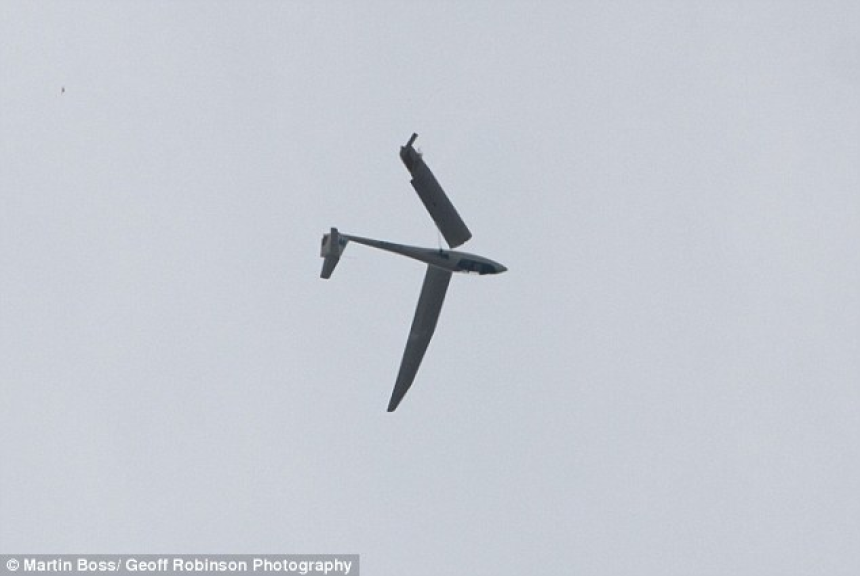
If you ever find yourself with an uneven or non-standard number of wings, your immediate action should be to say clearly and loudly, "Bail out, bail out, bail out." Even if you're alone, voicing this command aloud clarifies the instruction to yourself. It also kick-starts the adrenaline and endorphin flow, aiding in quicker reactions.
Don't concern yourself with the state of the glider's canopy, as this has just become the insurance company's property. Don’t worry about damaging the instrument panel. A well-placed boot is far more important, and, coincidently, at this point, the panel has also become the insurance company's responsibility. Your priority isn't the aircraft's condition but your safety and ability to accurately inform the insurance company where they can find their latest acquisition. As for the centre of gravity (CofG), it's likely moved into the next county, so let's forget about that as well!
The bailout sequence is Canopy-Harnesses-Butt-Pull.
1. Remove or open the canopy.
2. Unfasten your safety harnesses.
3. Do whatever it takes to get your butt out of the aircraft – kick, scream, shout, punch, pull, push, whatever it takes!
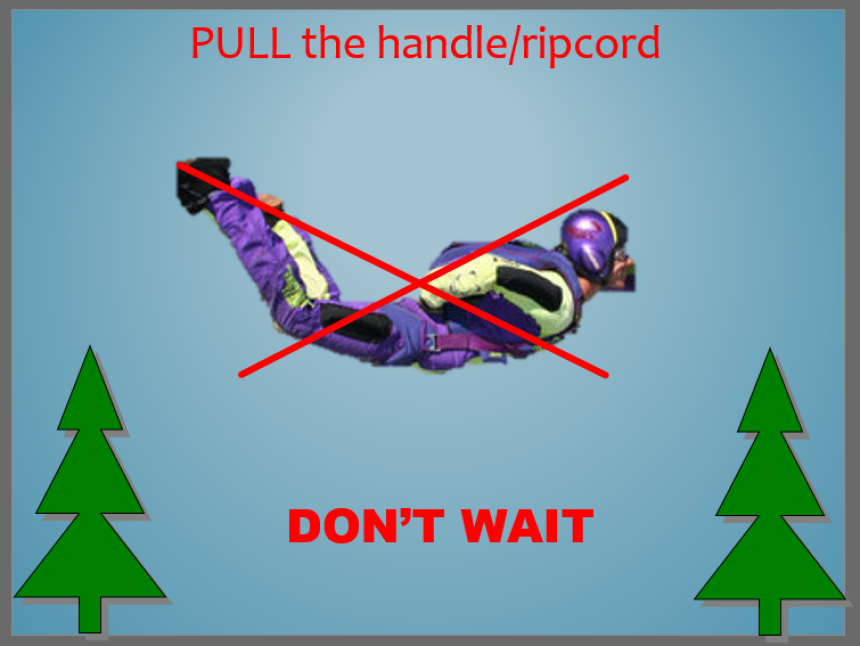
4. locate, grab, and pull the ripcord immediately without hesitation.
Prioritising the removal of the canopy significantly lowers the risk of becoming trapped, pinned in a position unable to access the jettison handles, which could happen if you unbuckle your safety harness first. After ejecting the canopy, there have been accounts from pilots who found it either stuck in position or digging further into the cockpit. Others have reported that the canopy vanished instantly, and upon releasing their harness afterwards, they were promptly outside the glider. These varying scenarios suggest that remaining strapped in is the safest approach when handling the canopy.
Point four about acting swiftly is crucial. You might have interacted with professional skydivers who use ram-air square parachutes (they are rectangular in shape, but we call them square as in not round). These are different from the round parachute you'll have in a glider. If not deployed in a stable, symmetrical position, square parachutes can have opening issues. You might have heard advice from these skydivers about being in a stable position before deploying the parachute. Please ignore them, well listen to me but ignore the others. You likely won't have the same amount of time or altitude as they do. They might deploy their parachutes at a minimum altitude of 2,500 feet, having had plenty of time to prepare for the opening. Conversely, you might be starting your newfound parachuting career from a much lower altitude and possibly above a thousand-foot-high ridge. QFE, QNH altitude, and height- we all know what these mean, but they do not tell you how high you are above the ground at this specific point. Therefore, immediate action is essential for your safety.
Regarding the question of altitude, just how low is too low for a safe bailout? It's important to know that a round parachute typically opens within 500 feet when deployed in sub-terminal velocity conditions. While terminal velocity is often described as around 120 mph, you're unlikely to be falling at that speed, hence the term 'sub-terminal'. In today's world, “where there’s blame, there's a claim”, I cannot definitively state a specific altitude guaranteeing safety upon jumping. However, I can suggest that if you find yourself at 500 feet, spinning uncontrollably with a malfunctioning glider, the likelihood of surviving an impact is slim. Deciding to jump in such a scenario could marginally improve your chances of survival. Opting to bail out early, higher, will be beneficial. Always read the label.
For many, this might seem like the end of the discussion, covering all the basic concerns. However, this is really just the beginning. You are now hanging potentially 2,000ft in the air under a parachute. There are many more questions to consider, such as understanding what your parachute looks like.
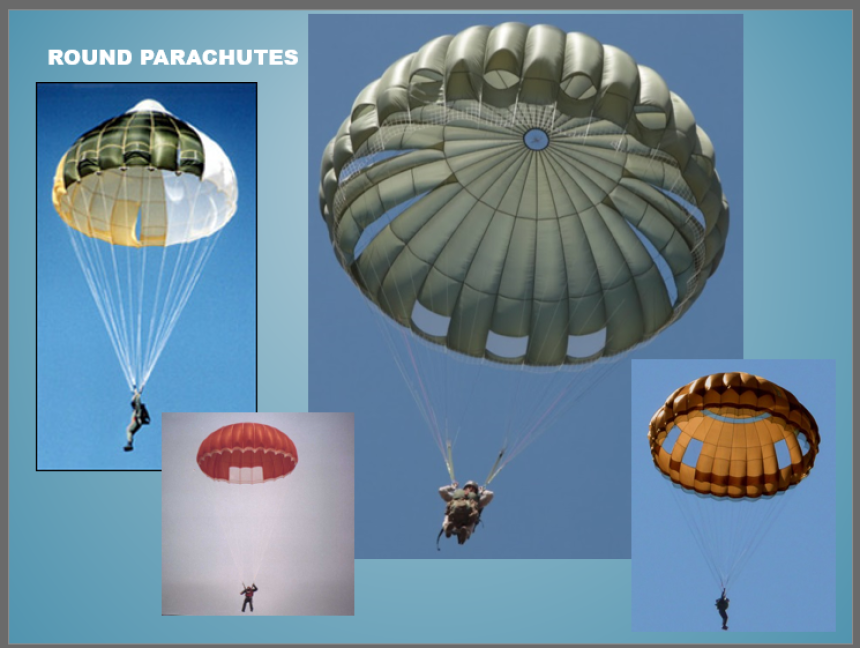
At the very least, you should be familiar with the colour and design of your parachute. Generally, these parachutes are round and feature at least one hole at the apex to minimise oscillations. Some parachutes are designed with additional holes and slits to provide a bit of forward motion, around 5 knots or so, and steering. So, if you do end up deploying your parachute and notice holes and slits, don't be alarmed; they are likely intentional. To avoid any surprises in an emergency situation, it's a good idea to contact your parachute supplier for a picture or diagram of your specific parachute. This way, you'll know exactly what to expect should you ever need to use it. A steerable parachute will typically have lines marked with a contrasting colour, often red. It may also have toggles located on the back of the risers, typically the back of the front pair. The risers are the pieces of webbing connecting the suspension lines to your shoulders. Steering is a simple process: pulling the left line or toggle turns you left, and pulling the right one turns you right.
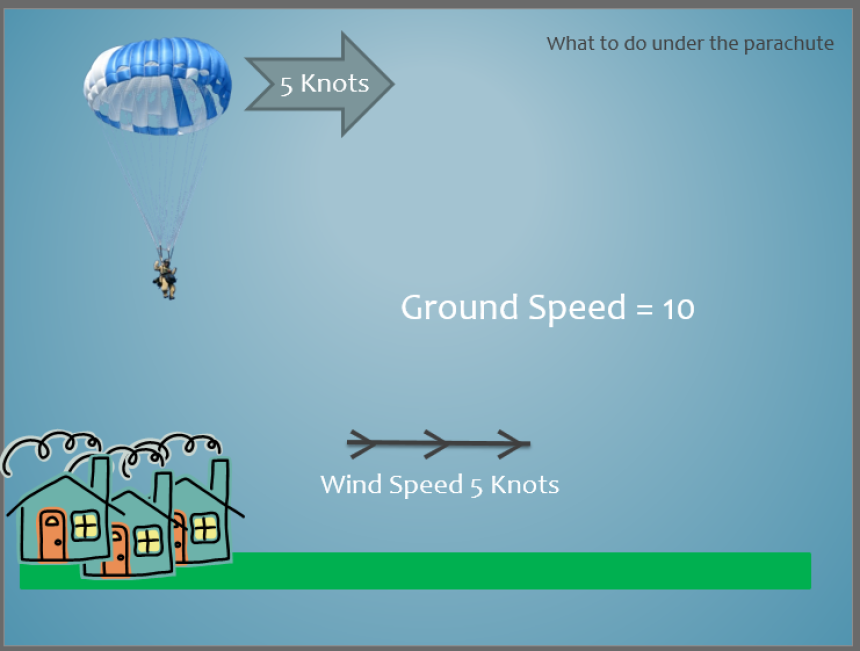
Having minimal forward speed and navigating with the wind helps avoid obstacles beneath you. If two people were on board, turning away from each other would be beneficial. In case of a potential collision with another parachute, adopt a starfish-like posture to reduce the risk of slipping through their lines and getting entangled.
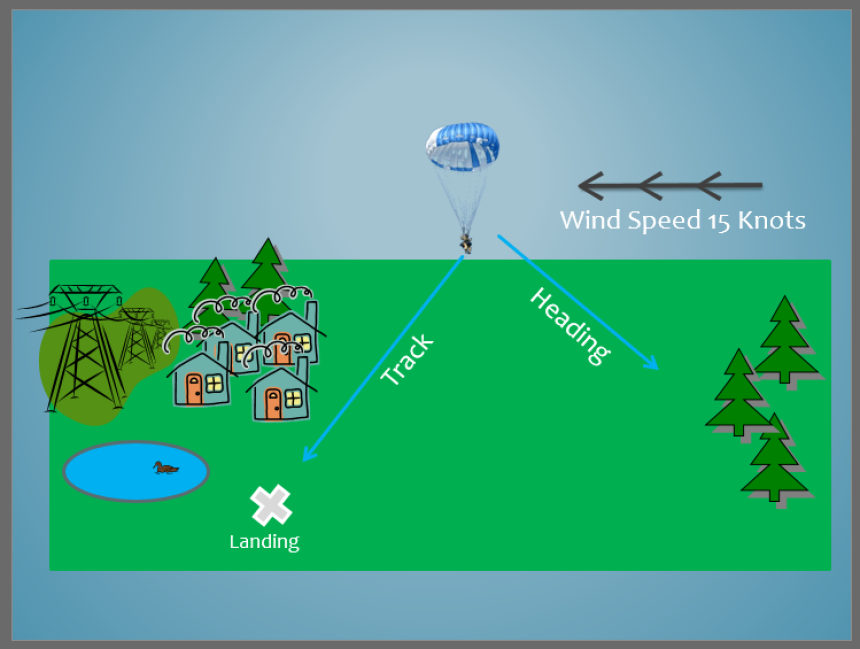
Alternatively, by changing your heading, you could navigate a path to avoid obstacles, effectively flying backwards. Look down along your leg past your foot to gauge your direction relative to the ground. This will help you assess your trajectory and determine your likely landing spot.
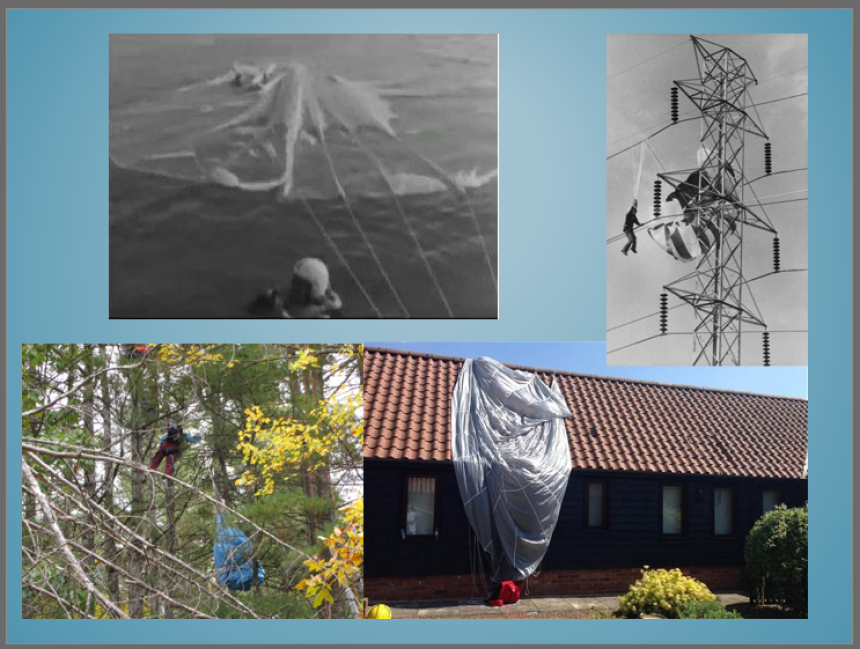
If your parachute isn't steerable, as is often the case with lower-cost models, or if you're unable to avoid obstacles, you might need to prepare for a landing on one.
Quick question: do you keep your mobile phone in the glider's side pocket or on your person when flying?
And, considering the scenarios in the photos above, where do you think those pilots might wish they had their phones right now? - landing in water might not be ideal either. It just was not their day!
Water Hazard
While a water landing might seem like a softer option, it's risky to assume the water is deep or free from submerged obstacles. There's also the danger of becoming entangled in the parachute. We're generally advised to swim downwards to escape from the lines and parachute. Emerging under a wet parachute could trap you, as pushing the canopy away might create a vacuum. Swimming down and away offers the best chance of freeing yourself.
Power Lines
Power lines are designed to trip and reset automatically after testing with a lower voltage. The power could be restored if you're hanging clear of the ground. Local help with an aluminium ladder might not be the safest option – you might still need to take charge of your own rescue.
Trees
Landing in trees comes with the risk that branches will eventually snap. A fall from 20 feet can be dangerous, even if you've just descended thousands of feet. There have been instances where people misjudged their height above the ground and sustained substantial injuries from a fall they thought was shorter. It is always best to wait for assistants rather than risk climbing down and slipping.
Buildings
When considering buildings, there are several important factors to keep in mind. Flat roofs might appear safe, but there's always the danger of your parachute, which just saved you, catching the wind and dragging you off the roof. Pitched roofs pose risks, as you might find yourself sliding down them, potentially falling from a height of around 20 feet or more. Additionally, some large factory roofs have warnings about the necessity of crawler boards. Without them, you might risk falling through to an uncertain environment below. The general advice is to distribute your weight evenly and cling to anything stable until help arrives. In the event that you start sliding, it's crucial to adopt the Parachute Landing Fall (PLF) position to prepare for the impact.
The best advice in these situations is to remain calm and stay put, waiting for assistance. However, remember that while you planned for this eventuality, your rescuers might not have. Be prepared to take charge if necessary. Once it's safe, promptly remove and secure your parachute harness. There have been numerous instances where individuals, having initially survived without injury, were later dragged or tripped by the wind re-inflating their parachute or by getting tangled in the lines, resulting in injuries.
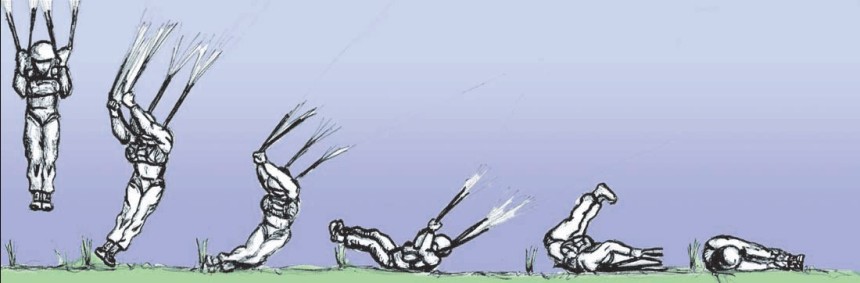
Expect a hard landing with your round parachute. Adopting the Parachute Landing Fall (PLF) technique is crucial for all landings, whether on the ground, into trees, onto buildings etc. Perfecting the roll takes practice, but keeping your feet and knees tightly together, knees slightly bent, chin on your chest, and covering your face with your elbows. This increases your chances of a safe landing. While it's often said in jest that these parachutes are designed so medical professionals can reassemble you, it's still preferable to the alternative.
Quick Recap:
1. How do we exit a glider?
- "Bail out, Bail out, Bail out" – Canopy, Harness, GO!
2. What’s the first action after exiting?
- Immediately pull the handle. Don't delay.
3. What should you do while descending under the parachute?
- Steer the parachute, if possible, and assess the drift and direction.
4. How do you land safely under a Parachute?
- Keep feet and knees together, Chin on your chest, and cover your face. Please don’t reach for the ground, it will find you.
5. Be prepared to take control.
- Have essential phone numbers and know who to contact (e.g., electrical companies).
This blog represents a compilation of my personal reflections and various reports I've encountered over the years. I encourage you to consult your Chief Flying Instructor (CFI) for specific queries or clarifications. Alternatively, feel free to reach out to me for further clarification. I have consciously refrained from proposing solutions for dealing with new students or trial flights. Several factors must be considered, such as the type of glider, canopy design, water presence, and ridge patterns. Offering specific advice could inadvertently lead to inappropriate guidance for certain scenarios. I hope the information provided here serves as a foundational reference for developing your instructional guidelines and contingency plans. Perhaps a few more letters to the mnemonic CB SIFT BEC around the Eventualities.
That leaves the “Who I’m I anyway.”
I started Skydiving in 1987 and still jump today, with over 3,800 jumps logged. I have UK PPL with SEP, SET, IR(r), Class Rated Instructor with FCL.940 privileges, Night, Tailwheel, and Sailplane Towing Rating. I’m a British Skydiving Jump Pilot, pilot examiner, and Chief Pilot at Skydive GB with 2,400hrs TT. I’m a Silver C glider pilot with 200hrs, mainly flying aerobatics and deputy Tug master at PSGC.
Gaining Sponsorship from Skydiving Equipment Manufacturers
Strategies for Visibility and Event Weekends


Lua script for the Thranda Cessna 208 on Xplane 12
Version 2.0 (this will be updated as I add to the project)
The Evolution of the Standard Overhead Join at UK GA Airfields
The overhead join has long been a staple in the United Kingdom's general aviation (GA) com...